Understanding Intercellular Communication Mechanisms
In this article, Intercellular Communication is described in terms of chemical messengers. This article will explain what the First messenger or ligand is, the Second messenger, the mode of action, and much more.
Table of contents
- Introduction
- Ligands or First messengers
- Second messengers
- The first step of intercellular communication i
- The second step is transduction,
- Phospholipase C activation:
Introduction
The body is made up of cells that communicate with each other to perform their functions properly and in a synchronized manner.
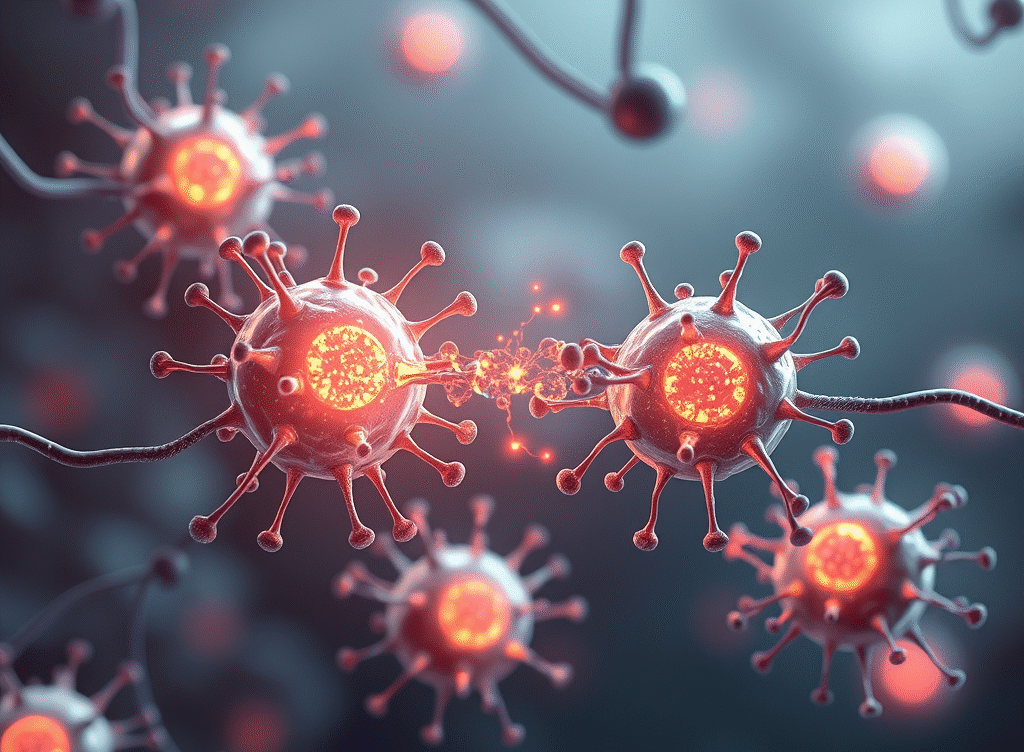
Intercellular communication refers to various methods that cells use to communicate with each other directly or indirectly through the extracellular fluid. This communication is complex and involves signaling pathways within a cell, enabling cells to respond to internal or external stimuli.
Intercellular Communication is vital for regulating cell functions, growth, division, genetic expression, and many other processes.
There are two types of intercellular communication. One is through chemical messengers, which is the primary type, and the other is through electrical signaling.
Ligands or First messengers
Intercellular Communication is mainly by various chemical messengers. Chemically, messengers may be amines, amino acids, polypeptides, lipids, or steroids, among others. The extracellular messengers are also known as ligands or First messengers. Ligands vary in chemical structure.
Ligands or First messengers may be endogenously secreted by body cells, for example, hormones, steroids. First messengers may be exogenous, meaning they are not produced by body cells; instead, they originate from outside sources, such as drugs.
Second messengers
The intracellular messengers, also known as second messengers, are present inside the cell. When a first messenger binds with its specific receptor, it causes the formation of second messengers. The primary second messengers are IP3, DAG, Calcium ions, cyclic AMP, and cyclic GMP. The second messengers usually activate Protein Kinases. The major Protein Kinases are:
- Calmodulin dependent
- Phosphorylase kinase
- Calmodulin kinase I, II, III.
- Myosin light-chain kinase
- Protein kinase C
- C AMP dependent protein kinase A
- C GMP dependent kinase.
Movement of First messengers:
- They move from cell to cell via gap junctions, without entering the extracellular fluid.
- They may act on the cell that produces them, an autocrine effect.
- They may act on adjacent cells by paracrine effects.
- They are secreted into the bloodstream and transported to the target cells through the blood to exert their effects.
Intercellular communication is by:
- Endocrine communication
- Paracrine communication
- Autocrine communication
- Neural communication
Mode of action of First messengers:
Extracellular signaling molecules or electrical fluctuations, such as action potentials, trigger a series of events that lead to the desired effects. To produce and trigger events, the proper concentration of the first messenger or the appropriate strength of the action potential is essential.
The first step of intercellular communication i
The first step of intercellular communication is the reception of signals. For this, cells have many receptors on their cell membrane, in the cytoplasm, and the nucleus. Receptors are specific; they bind with specific signals.
The second step is transduction,
As soon as a receptor binds to a first messenger, it triggers a series of events, molecular changes in the cell known as signal transduction, leading to a specific cellular response.
Second messengers release signals from the cell membrane to the cytoplasm and nucleus.
The mode of action of ligands
Some ligands bind directly to ion channels present on the cell membrane and alter membrane permeability to that ion. It can open or close ion channels, causing an increase or decrease in the permeability of that ion, respectively.
For example, A-ch is on the motor end plate.
Transcription stimulation:
Stimulate cytoplasmic or nuclear receptors to increase transcription of mRNA.Thyroid and steroid hormones are examples. Some ligands enter the cell and bind to receptors present in the cytoplasm and nucleus.
Phospholipase C activation:
Phospholipase C is present on the inner surface of the cell membrane. When a ligand binds to its specific receptor, it activates Phospholipase C, which in turn catalyzes the hydrolysis of Phosphatidylinositol diphosphate(PIP2), to form Inositol triphosphate IP3 and Diacylglycerol (DAG).
These two molecules act as second messengers.
1.IP3 diffuses into the cytoplasm and to the endoplasmic reticulum (ER) and triggers the release of calcium ions into the cytoplasm to exert physiological effects.
2. DAG remains in the cell membrane and activates protein kinase to produce specific physiological effects.
Clinical:
Any defect in the intercellular signaling communication mechanism will cause and contribute to the development of diseases.