Normal Range and Factors Affecting Cardiac Output
Introduction: Cardiac Output is the volume of blood pumped out from each ventricle in one minute. Cardiac output is an essential parameter in hemodynamics, the study of blood flow. Its importance is globally accepted.
In this article, you will get a definition of cardiac output, standard range, and more.
Table of contents:
- What do you mean by cardiac output?
- What is the Normal Range of Cardiac Output?
- What is Cardiac Index?
- Factors Affecting Cardiac Output
- Measurement of cardiac output:
- Importance of cardiac output:
What do you mean by cardiac output?
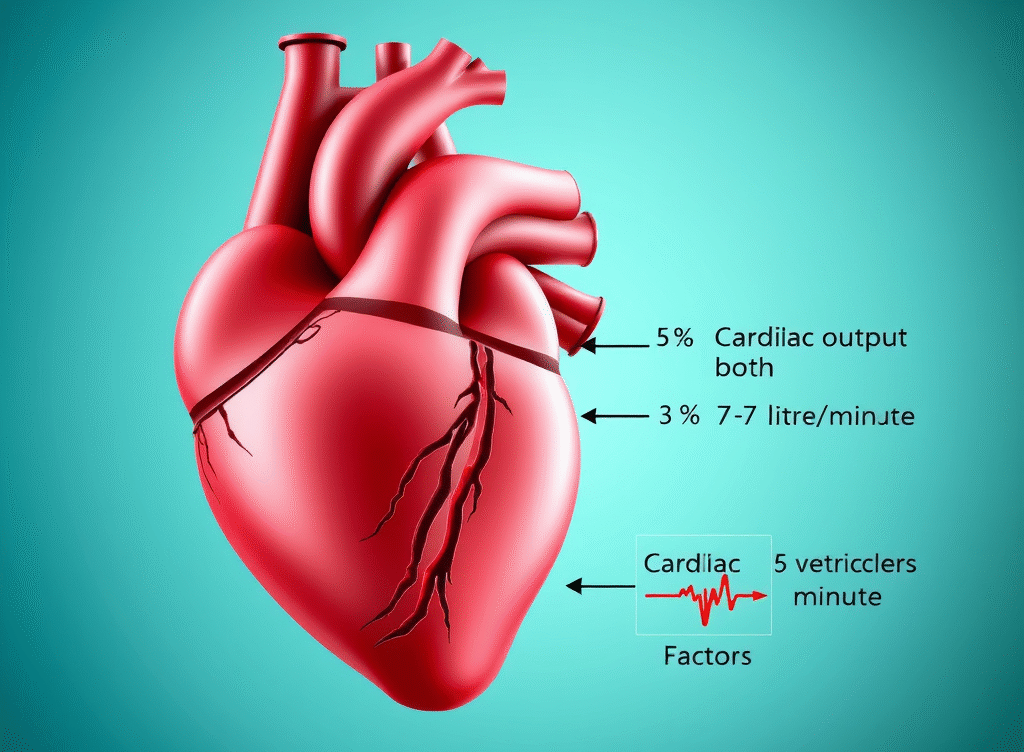
Cardiac output is the blood volume pumped from each ventricle per minute, expressed in liters /per minute.
It is denoted by Q.
The output of the two ventricles is the same.
The two ventricles eject the same amount of blood.
Each ventricle pumps 5 to 6 liters of blood per minute.
What is the Normal Range of Cardiac Output?
The normal range is 5 to 7 liters/minute.
Average 5.5 liter/minute.
For a healthy individual of 70 kg, the cardiac output at rest is 5 L/ minute.[Heart rate 70 beats per minute and stroke volume about 70 ml.]
Cardiac output equals the product of heart rate [beat per minute] x stroke volume.
Cardiac output =heart rate x stroke volume.
[Stroke volume is the blood pumped by each ventricle per beat. The average volume is 70 ml. [Range is 60- 80 ml.]
We use the Fick Principle to obtain the cardiac output.
CO= VO2 / Ca-Ca
CO =cardiac output
VO2=Oxygen consumption in ml of pure O2 per minute.
Ca =Oxygen content of arterial blood.
Cv=Oxygen content of venous blood.
Cardiac output depends on an individual’s height and weight.
What is Cardiac Index?
We can determine cardiac output by calculating the cardiac index.
The cardiac index is defined as cardiac output per square meter of body surface area.
The typical value is 3.2 L/M2 /Minute.
The average value is 2.5-4 L/m²/Minute.
Cardiac output is affected significantly by respiration.
The body’s oxygen demand mainly controls cardiac output. When the body’s oxygen needs increase due to increased metabolism, blood flow back to the heart increases, leading to high cardiac output. The heart is a demand pump; it regulates its output according to the body’s demand.
Factors Affecting Cardiac Output
Cardiac output is affected
1. Significantly by respiration.
2. Height and weight of an individual.
3. By heart rate
4. By stroke volume
Measurement of cardiac output:
We can measure cardiac output using several methods. Some are invasive, and some are non-invasive. There is a list of a few methods:
1. Invasive and 2. Non-invasive
Invasive methods: Direct intracardiac catheterization
The non-invasive method is well accepted. They are
i.Ultrasound method
ii Doppler effect
iii Echocardiography
Importance of cardiac output:
Low cardiac output
Low cardiac output indicates shock, low venous return, myocardial insufficiency, heart failure, and other cardiac dysfunctions.
High cardiac output
High cardiac output occurs in conditions such as anemia, sepsis, hyperthyroidism, and increased venous return, as seen during pregnancy.